Showing posts with label analog. Show all posts

Tuesday, July 28, 2009

WSBE "Learn" More


The digital conversion earlier this year was rocky for some, and no sweat for others. But how ever you weathered the revolution, all of your local television stations emerged with new channel choices for your enjoyment. WSBE Rhode Island PBS, for example, broadcasts on two over-the-air channels: its main schedule on 36.1 (formerly known as analog "36"), and WSBE Learn on 36.2. Of course, those channel numbers are only meaningful to you if you watch TV over-the-air, but it's a pure, basic starting point. Cable and satellite TV services have WSBE all over the place channel number-wise. More on that - and a clear Finder's Guide - in an upcoming blog!

The prime time programming on WSBE Learn has evolved nicely since we first started broadcasting almost two years ago. (That's right, two years! But most of that was in obscurity until Cox finally picked up the channel in February.) As for the schedule itself, it's different from WSBE Rhode Island PBS - both in broadcast dates/times as well as content. Learn airs some series that are not broadcast on WSBE Rhode Island PBS: Austin City Limits, NewsHour, plus Tracks Ahead, Africa Trek, and From the Top at Carnegie Hall. Some main channel favorites are featured, of course, but on different days and at different times: American Experience, Scientific American Frontiers, P.O.V, Independent Lens, Great Performances, and a variety of How-To series from This Old House, to Everyday Edisons, to America's Test Kitchen, and more.

Visit www.ripbs.org and click TV SCHEDULE (your second option from the left on the menu under the welcome banner) for the schedules for both channels!

As always, your comments and questions are always welcome - post it here, or send an email to public @ the station Web site.

- LMR
Public Information Manager

Friday, January 16, 2009

WSBE Analog Transmitter Meets Premature Demise

It was bound to happen sooner or later. In fact, it's surprising it hasn't happened sooner.

The WSBE analog transmitter on Neutaconkanut Hill near Johnston died quietly overnight yesterday. May it rest in peace...

It certainly earned its rest. The transmitter is about 23 years old. It was the last transmitter made by RCA. Parts? They haven't been manufactured in years, and it's been increasingly impossible to find spare parts from relic transmitters. Our repairs have been made by creatively adapting or modifying similar parts - an art in itself to be sure.

But we were hoping it would hang in there for just one more month - until February 17, the date all TV broadcasters switch off their analog transmitters forever. But instead of chugging on to enjoy an official, dignified demise, the ol' transmitter unceremoniously kicked the bucket a little prematurely.

The transmitter needs a cooling unit to operate. The cooling unit circulates about 30 gallons of distilled water. Even when the transmitter is turned off every night, a pump keeps the water moving. Sometime yesterday - one month before our official scheduled shut-off - the cooling system developed a deadly leak. Powered by the pump, the water leached out of the transmitter, in what is known as a "catastrophic failure."

Despite the gloomy prospect, our engineers looked for solutions to get us up and running again. Estimates were it would take a minimum of two weeks to fix (including the hunt for parts and then repairs), and at a conservative cost of $2,500. That's a lot of money, and simply not justifiable with only 30 days left on analog transmission. That is a catastrophic failure with no recovery.

If you're seeing that annoying hissing broadcast snow on channel 36, you don't have your analog-to-digital converter box hooked up yet. What are you waiting for? We and all the local broadcasters - WJAR-10, WPRI-12/Fox-64, WLNE-6 - have been broadcasting digital for well over a year.

How do you get back your favorite Rhode Island PBS programs? Get a digital-to-analog converter box and connect it to your analog TV set. The converter box is a one-time purchase. (You may also want or need an antenna to boost your signal.) You can also opt to subscribe to digital cable or satellite service, or buy a new TV with a built-in digital tuner. These are the same options from which you must choose by February 17th anyway. The early death of our transmitter is just an added incentive to take action NOW.

Questions? Give us a call at the station: 401-222-3636.

Tuesday, February 12, 2008

The Day TV Screens Go Blank


No, the sky isn't falling.

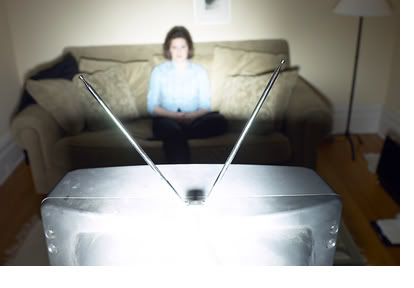
But if you haven't bought a TV set recently and you receive your television signal over-the-air only (with perhaps a little help from "rabbit ears" or a rooftop antenna), you might think the sky has fallen one year from now when your TV stops working.

Why?

Because older TVs receive what are called "analog" signals, and the federal government has mandated that all full-power TV stations must stop transmitting analog signals on February 17, 2009. Forever.

"What? Did you say 'No TV'?"
That depends. Most Rhode Island PBS viewers will not notice any difference because they already subscribe to digital cable or satellite services. However, if you receive your signal over-the-air on an older TV set, you will be affected by the transition and will need to take action to continue watching television.

All public television channels, including digital channels, will continue to be available free of charge to all Americans. But you must have a way to receive the digital signal.

Can I continue to use the TV set I have now?
Sure, but not without making some changes.

Rhode Island PBS is not here to sell new televisions, or to advocate for subscription television services. We are here to provide you with basic information and point you to resources to help you make the best decision for you and your family.

If you subscribe to cable or satellite, chances are very good your access to broadcast channels will not change. Please check your billing statements or contact your television service provider to be sure the equipment in your home meets the digital television standard.

The conversion will impact you if you currently rely only on over-the-air signal on an analog television and a "rabbit ears" or rooftop antenna. Consider also whether you have a second television that is not connected to your cable or satellite service, because it, too, will be affected.
If you depend on over-the-air analog signal to watch television, you have these options:
  1. Buy a converter box.*(see more information below) The digital television (DTV) converter box makes it possible to see digitally broadcast television programs on an older existing analog TV set and allows you to keep your free, over-the-air television service. DTV converter boxes, which will be available for purchase beginning in March 2008, are expected to cost between $40 and $70. A limited supply of coupons is available from the federal government to reduce the price of certain converter boxes by $40. This is a one-time cost for the box; it does not require a monthly service fee.
  2. Buy a new digital television set with a built-in digital tuner.

  3. Subscribe to digital cable or digital satellite television service.
Any of these options will ensure that over-the-air television viewers will continue to receive a picture, but the costs vary with each option.
Whatever you decide, you have until February 17, 2009, to prepare for the digital transition. After that date, you will no longer be able to view your over-the-air broadcasts on your analog TV.
What if I do nothing?
  • If you don't have digital cable or satellite, or
  • If you don't have a newer model TV with a built-in digital tuner, or
  • If you don't buy a digital converter box, your analog television will not work after February 17, 2009. Period.
*How can I get a low-cost converter box?
In order to help consumers with the digital transition mandated by the Federal Communications Commission (FCC), the federal government has created a coupon program that will reduce the cost of buying a digital converter box. The coupons (limited to two per household, and available in limited supply) are valued at $40 each, and will be redeemable at select retailers. Some converter boxes will offer enhanced features, but please note that only approved converters are eligible for the Coupon Program. Approved model numbers, locations of retail stores, and other information you need to choose the right converter box will come with your coupon. Also, although you should order your coupon(s) now, coupons will only be mailed when the converters are available in stores in our area.

To learn more about the coupon program, including how and when to request and redeem your coupons, please visit Digital-to-Analog Converter Box Coupon Program. Consumers may also call a toll-free number, 1-888-388-2009 (1-888-DTV-2009). You can also download the fact sheet from the National Telecommunications and Information Administration:
For more information on the digital transition
And if you have any questions, feel free to ask them here!